

Beyond the Wire
Direction and Script: Dorino Minigutti
Script Consultant: Boris Gombač
Director of Photography and Cameraman: Bruno Beltramini
Music: Aleksander Ipavec
Sound Recording and Design: Francesco Morosini
Animation Author: Ernesto Zanotti
Editor: Sanjin Stanić
Assistant Directors: Ivana Paškvan and Maja Stegovec
Executive Producers: Patrizia di Lenardo, Aleš Doktorič, Maja Stegovec, Irena Marković
Producers: Dorino Minigutti, Aleš Doktorič, Nadja Velušček, Irena Marković
Production: Zavod Kinoatelje (SLO), Immaginaria (I), Focus Media (HR), Agherosé (I)
Production Year: 2012
Language: Slovenian/Croatian/Friulian, with Slovenian subtitles
Format: HDCAM, 85'
Feature documentary film about a concentration camp
Synopsis
Childhood is perhaps the only time when one can freely and carelessly flow with the stream of desires. It is during this period that one is most impressionable yet most vulnerable: the images and experiences from this time shape one's life forever. For the better, of course; but unfortunately, also for the worse.
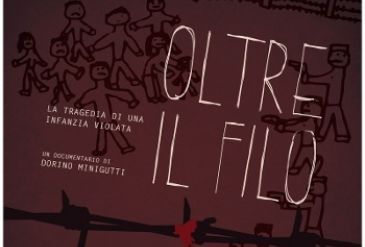
The documentary Beyond the Wire walks through lesser-known landscapes of World War II, described through the perspective of children. The intertwining memories form a poignant narrative of survivors from the Gonars camp in Friuli, whose childhood was left on the other side of the barbed wire. They were deported from various parts of what is now Slovenia, mainly from Ljubljana, Kočevje, Gorski Kotar, and Istria, as well as transferred from the Rab camp. They were too young to understand why they were there, but old enough to maintain their will to live, and also to create. "This was a unique case in occupied Europe, where children wrote about their suffering during the war," says one of the witnesses. The past serves as a foundation for the future: more than sixty years later, children in a classroom read the writings of their peers who had been interned, illustrate them, ask questions... Their view of the events is different from that of the adults, yet no less grounded; the questions that may seem naïve at first are, in fact, much clearer and more demanding, for they require precisely such answers. After all, who would understand the concept of stolen childhood better than a child?
The collected testimonies of the children are much more than just a living monument reminding us of one of the greatest atrocities of the 20th century. They are primarily confessions of individuals who gathered enough courage to turn the page to a new life.
Chronology
On April 6, 1941, Hitler and Mussolini occupied Yugoslavia. The Slovenian territory was divided between Germany and Italy, with the latter forming the Ljubljana province. From the autumn of 1942, the Italian army carried out a series of attacks on the civilian population south of Ljubljana to halt the Slovenian resistance movement. They used the same methods as the Nazis on the Eastern Front: burning villages, shooting hostages, and mass deportations to concentration camps in an effort to cut off support for the partisans.
More than 30,000 people were interned, mostly women, but also the elderly and children. In Gonars, in the Friuli-Venezia Giulia region near the city of Palmanova and the old Austro-Hungarian-Italian border, a "concentration camp for civilians" operated from the spring of 1942 until September 1943. In eighteen months, over 400 people died in Gonars, 71 of them children under one year old. In 1973, at the initiative of the Socialist Federal Republic of Yugoslavia, a monument was erected in Gonars to commemorate the 453 people buried there.
Director's Statement
Only recently did I discover that an Italian "concentration camp" once stood just a few kilometers from my home in Friuli. While its scale is incomparable to the Nazi camps, the camp in Gonars was a place of suffering and death. I enjoy telling stories that are somehow connected to me and that relate to the themes of my previous work.
My attention to the world of children, the importance of memory, and its changing nature over time led me to Gonars. Without any rhetoric, I wanted to discover what lies behind those children's drawings that speak of suffering but also of dreams and hope. What remains of those memories and what have the grandchildren of those children preserved today?
The witnesses remember their traumas, the invisible marks that follow them through life. The red thread of the documentary film, with which I wanted to enter the past and simultaneously leave it, is childhood. The words and drawings of those children, through the eyes of today's generation.
The film is not a story with a happy ending, but simply a testimony that proves that humanity and solidarity can triumph over hatred.
Dorino Minigutti
Dorino Minigutti – Screenwriter, Director, and Producer
Born in 1961 in Palmanova. He lives and works in Udine (Italy) as an independent author and producer. In collaboration with the Regional RAI headquarters for Friuli Venezia Giulia and other public institutions, he has made numerous documentaries and educational films with a social focus. Since 1989, he has been working long-term with public health structures and coordinated video labs and creative writing workshops within psychological rehabilitation. From 1993 onwards, he has written and directed several educational films in the Friulian language for the University of Udine, as part of EU projects for minority languages. Currently, he is working on a project about private audiovisual archives and historical memory from the end of World War II to the present.
As a documentary filmmaker, some of his notable works include:
- Il parco, l’acqua e la luna (Park, Water, and Moon, 1994) – Libero Bizzari Award ’95 and official selection at the 42nd Trento Mountain Film Festival (I)
- Il filo rosso (The Red Thread, 1998) – 1st prize at Videoland 1998 and selection at the Maremma Festival 1998
- Nûfcent – Videosclesis dal Friûl (20th Century. Video Clips from Friuli, 2006) – 1st prize Mario Quargnolo 2007, 1st Prize Premio “Renato Appi” 2006, Mention at Videoland 2005
The documentary Beyond the Wire was created as an international co-production after producers Dorino Minigutti, Aleš Doktorič, and Irena Marković participated in the interregional workshop EURODOC held in Gorizia (Italy) in the autumn of 2009.
Interesting Facts
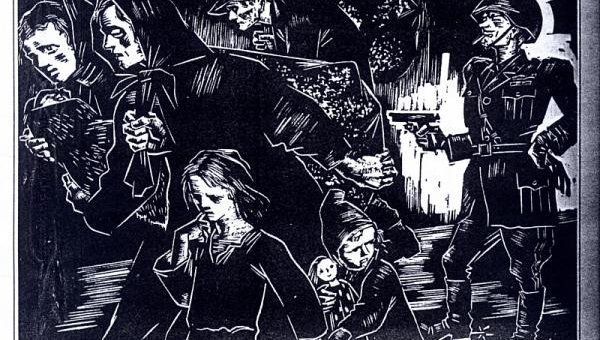
In the Gonars camp, notable Slovenian academic painters, as well as some self-taught artists, were interned, leaving behind an extensive and invaluable body of artwork. This visual material, the only surviving documentation, is kept in the Museum of Contemporary History and testifies to the suffering and horrors of the time. Among them were Nikolaj Pirnat, Drago and Nande Vidmar, Stane Kumar, Vlado Lamut, Marijan Tršar, Slavko Balentin, and others.
An important document of the time that witnesses the events before, during, and after internment is also the writings of children that were created upon their return home, in the then partisan schools. A competition with therapeutic-memory content, “Children Speak to Us” and “Our Children in Internment”, was organized. Through writing and drawing traumatic experiences from the camp days, the aim was to help children overcome the trauma and consequences left by the war and the experience of the camp. These writings are a unique example in Europe of children writing about their suffering during the war.
The documentary film was developed under the direction of Italian filmmaker Dorino Minigutti, with assistance from Slovenian historian Dr. Boris Gombač, who, together with Metka Gombač and Dario Mattius, conducted the research, exhibition, and publication When My Father Died – Drawings and Testimonies from Concentration Camps on the Italian Eastern Border (1942-1943).
Beyond the Wire was produced as an international co-production after the participation of producers Dorino Minigutti (also the author), Aleš Doktorič, and Irena Marković in the first interregional workshop within the EURODOC program, which took place in partnership between audiovisual funds of Friuli Venezia Giulia (Fondo Regionale per l'Audiovisivo), Slovenia (formerly the Film Fund of the Republic of Slovenia), and Croatia (Hrvatski Audiovizualni Centar).
Kinoatelje, which includes the Slovenian production Zavod Kinoatelje, operates in Italy and Slovenia as a multi-functional hub for intercultural and cross-border projects in the field of film and audiovisual media. It combines event and publishing activities, research and archival work, as well as video and film production.
Directed by: Dorino Minigutti